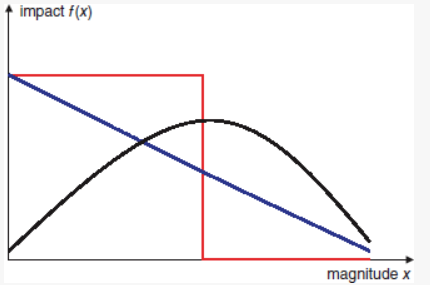
Many of the spatial models we have explored so far involve binary or Boolean expressions that subdivide intermediate data based on some fixed condition: e.g., in the frog habitat algorithm, why can frogs only live within 50 m of a stream? This fixed condition seems arbitrary; we could imagine a brave frog forging ahead, and settling down 51 m, or even 52 m from a stream. Nature doesn’t obey such binary constraints!
An alternative to such a fixed constraint is a fuzzy constraint, something we will explore more after the break.
In modeling, we can apply weights based on prior knowledge about a process to produce a filter for frog habitat-stream distance that is continuous rather than static. This is the essence of multicriteria modeling.
Defining weights can be challenging, but their benefits are profound. In a multicriteria frog habitat model, the probability of frog habitat being located within some X distance of a stream will decay continuously with distance from a stream. This opens the possibility for our brave froggies settling down in a bog 55, 60, even 70 m from a stream. But, the weight will decrease the likelihood of such resilient amphibians living so far from their watery home according to some weight function.
For examples of weighting in modeling, See the types of models page, and examine the architecture of the aggregate model example. Generally, we could imagine thresholds for these weights being set by (1) step (2) linear (3) or Gaussian weights: